import jax.numpy as jnp Vs import numpy as np, computations are done using numpy like interface, same code can run on cpu, gpu, tpu and local and distributed too.
just-in-time compilation via Open XLA.
In general jax operations happen one at a time
jax.jit decorator allows bunch of code to be optimized and run at once
gradients can be calculated for JAX functions using automatic differentiation transformation.
JAX functions can be automatically vectorised, ie, mapping over batch of inputs.
Tip
Use duck typing to replace jax arrays with numpy arrays, but jax arrays are immutable.
JAX arrays
provided by jax.Array, but mostly created using jnp API.
if x: jax.Array; x.devices() and x.sharding allows us to inspect location and sharding.
import jax.numpy as jnpdef norm(X): X = X - X.mean(0) return X / X.std(0)from jax import jit# can be considered as norm_compiled.jit_norm = jit(norm)np.random.seed(0)X = jnp.array(np.random.rand(1000, 10))np.allclose(norm(X), jit_norm(X), atol=1E-6)%timeit norm(X).block_until_ready()%timeit jit_norm(X).block_until_ready()
JAX uses asynchronous dispatch so we need to use block_until_ready.
JAX.JIT LIMITATION
all arrays should have static shapes
def get_negatives(x): return x[ x < 0 ]x = jnp.array(np.random.randn(10))# ERRORget_negatives(x)jit(get_negatives(x)) # will give an error
tracing and static variables
JIT and JAX transforms work by tracing a function
helps determine how function effect on inputs of specific shape and type.
{ lambda ; a:f32[3,4] b:f32[4]. let
    c:f32[3,4] = add a 1.0:f32[]
    d:f32[4] = add b 1.0:f32[]
    e:f32[3] = dot_general[
      dimension_numbers=(([1], [0]), ([], []))
      preferred_element_type=float32
    ] c d
  in (e,) }
JIT cannot be used on control flow statements, static variables help us here.
@jitdef f(x, neg): return -x if neg else xf(1, True)
TracerBoolConversionError: Attempted boolean conversion of traced array with shape bool[].The error occurred while tracing the function f at /tmp/ipykernel_4292/2422663986.py:1 for jit. This concrete value was not available in Python because it depends on the value of the argument neg.See https://docs.jax.dev/en/latest/errors.html#jax.errors.TracerBoolConversionError
from functools import partial@partial(jit, static_argnums=(1,))def f(x, neg): return -x if neg else xf(1, True)
Array(-1, dtype=int32, weak_type=True)
If we change the static arguments then recompilation will happen.
Derivatives with jax.grad
jax.grad transformation is used for automatic differentiation
jax.jacobian transformation is used to compute full jacobian matrix for vector-valued functions.
Jacobian vs Grad
jacobian is for vector valued functions, whereas, grad is for scalar valued functions.
jacobian is matrix, where as grad is vector
REVISIT THIS PART LATER
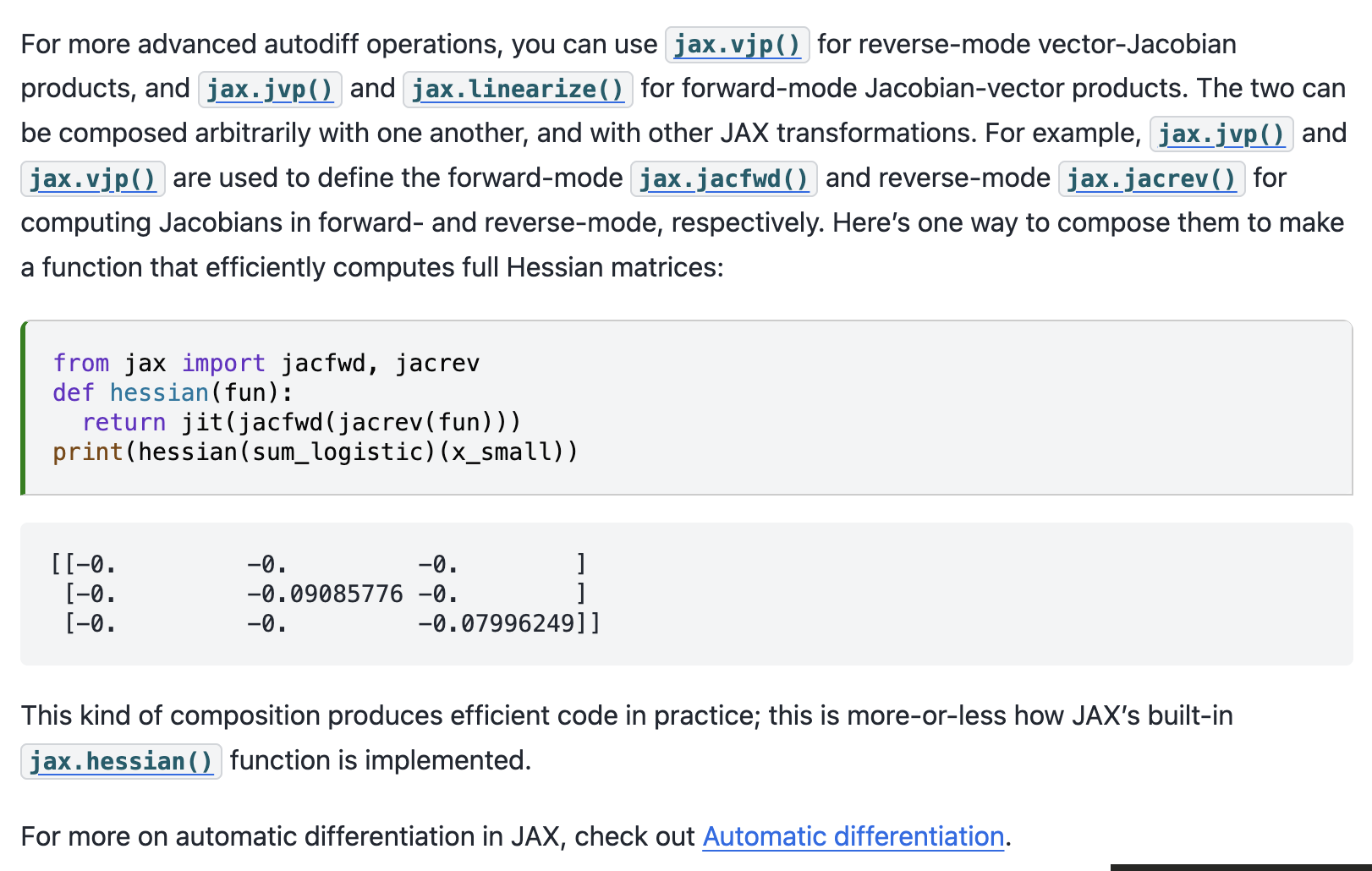
No proper knowledge of hessian, jacobian vector product and vector jacobian product.
Tip
multiple transformations can be composed grad(jit(grad(f)))(x)
from jax import randomkey = random.key(1)key1, key2 = random.split(key)mat = random.normal(key1, (150, 100))batched_x = random.normal(key2, (10, 100))def apply_matrix(x): return jnp.dot(mat, x)def natively_batched_apply_matrix(v_batched): return jnp.stack([apply_matrix(v) for v in v_batched])def batched_apply_matrix(batched_x): return jnp.dot(batched_x, mat.T)
from jax import numpy@jitdef vmap_batched_apply_matrix(batched_x): return vmap(apply_matrix)(batched_x)
Pseudorandom numbers
JAX random functions consume a random key that must be split to generate new independent keys.
JAX random key model is thread-safe and avoids issues with global state. [dig deeper]
numpy uses global state, set using numpy.random.seed
issue: global state won’t work with JAX computation model, reproducibility over different threads, processes and devices.
solution: track the state explicitly using random key.
The rule of thumb
never reuse keys (unless we want identical outputs).
for i in range(3):
	new_key, subkey = random.split(key)
	del key # consumed by split.

	val = random.normal(subkey)
	del subkey # consumed by normal.

	key = new_key # new_key is safe to use in next_iteration.
np vs jnp & static vs traced
use numpy for operations that should be static (i.e. done at compile time) and use jax.numpy for operations that should be traced.
Jaxpr
jax uses tracer to extract operations performed in a function, which are stored in jaxpr syntax.
jax.make_jaxpr
Pytrees
JAX functions and transformation fundamentally operate on single array.
But in practice we encounter collection of arrays, like neural network.
JAX relies on Pytree abstraction to treat such collections in uniform manner.
 REVISIT THIS PART LATER